September initialization · ECMWF SEAS5 calibrated with CHIRPS · ONDJ R3 (Deyr) rainfall domain
ONDJ 2026/27 rainfall outlook
Research reconstruction · not an official EMI or ICPAC forecastTarget period ongoing (ends 31 Jan 2027)
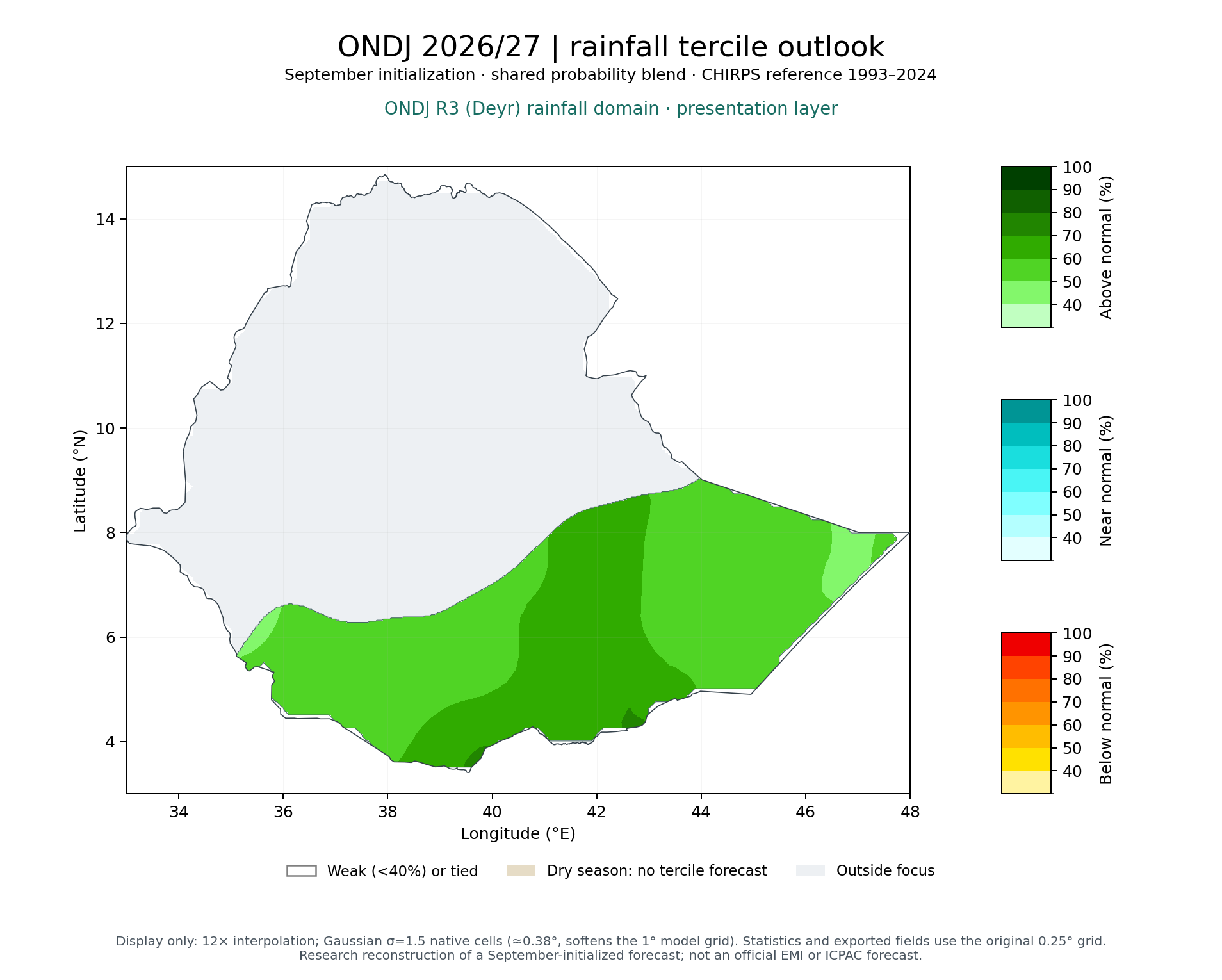
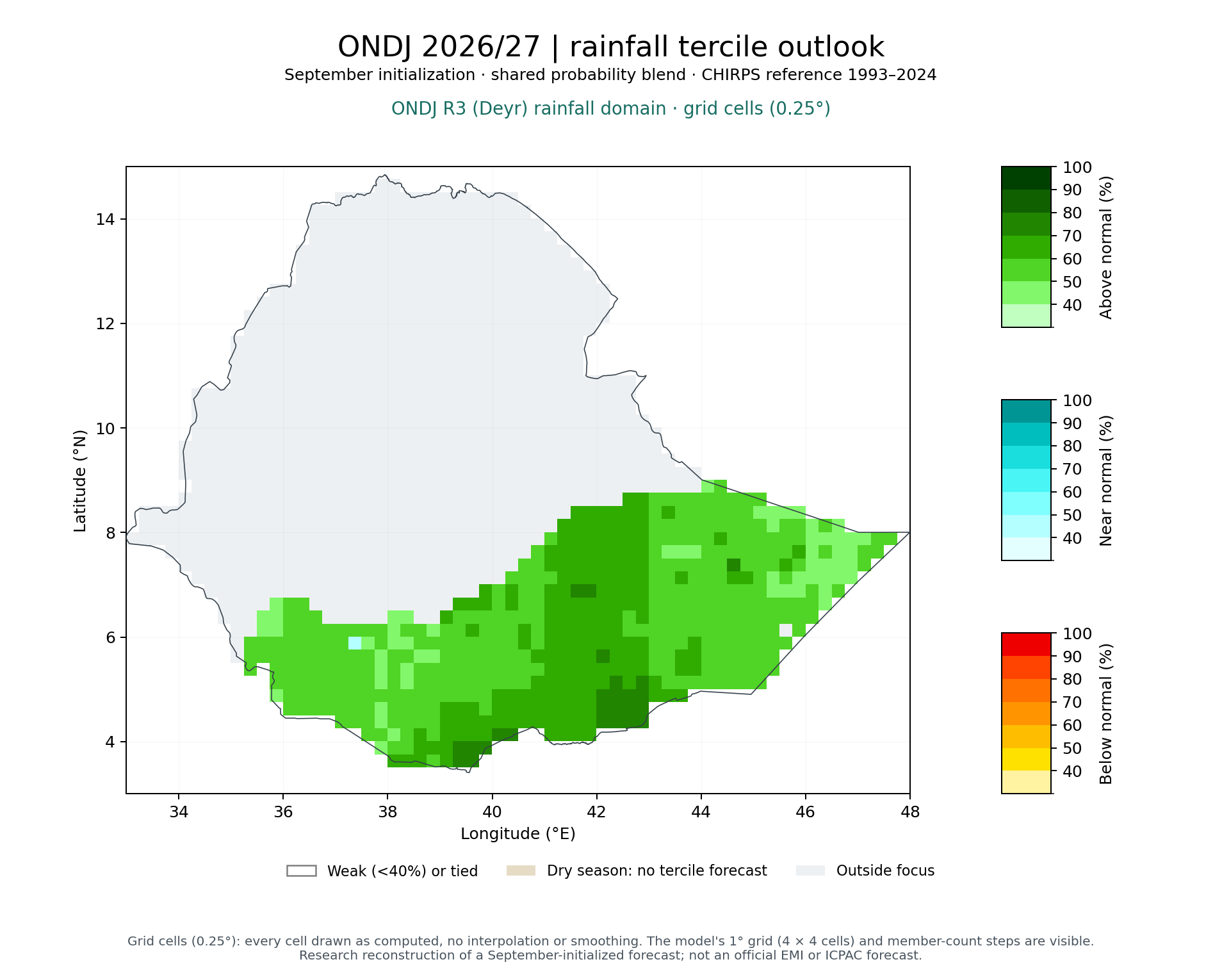
The forecast leans toward above normal rainfall in the ONDJ R3 (Deyr) rainfall domain: averaged over the area, the local probability of above normal is 58%, against about 33% for climatology. Mean forecast rainfall is 265 mm against a 1993/94–2024/25 average of 188 mm (+77 mm, +41%).
Average local probability
Each grid cell has its own tercile probabilities; these are their averages over the 100% of the area that has probabilities. They are not the probability that the area-total rainfall falls in a category.
Rainfall amount
Amounts cover 100% of the area. They come from the amount-corrected ensemble, calibrated separately from the probabilities, so the two can differ slightly.
Forecast signal
Strong tilt toward above normal
Largest area-average probability 58%, compared with a one-third reference. The local climatological probabilities (observed tercile frequencies in the training years) are close to, but not exactly, one-third. Based on probabilities only.
Historical skill — ONDJ R3 (Deyr) rainfall domain
Moderate improvement over climatology (interval above zero)
Probability skill (RPSS) +0.133 for ONDJ, cross-validated 1993–2016 (95% interval +0.032 to +0.245); better than climatology in 18 of 24 years. One-target p = 0.010; adjusted for testing 5 targets (Holm), p = 0.040 (still significant). Details
Signal strength describes how far this forecast's probabilities depart from climatology. Historical skill describes how forecasts made the same way scored in past years. A strong signal is not a confidence rating.
ONDJ 2026/27 — September initialization: every target
-
ONDJ 2026/27
B 16% · N 26% · A 58%
Target period ongoing (ends 31 Jan 2027)
-
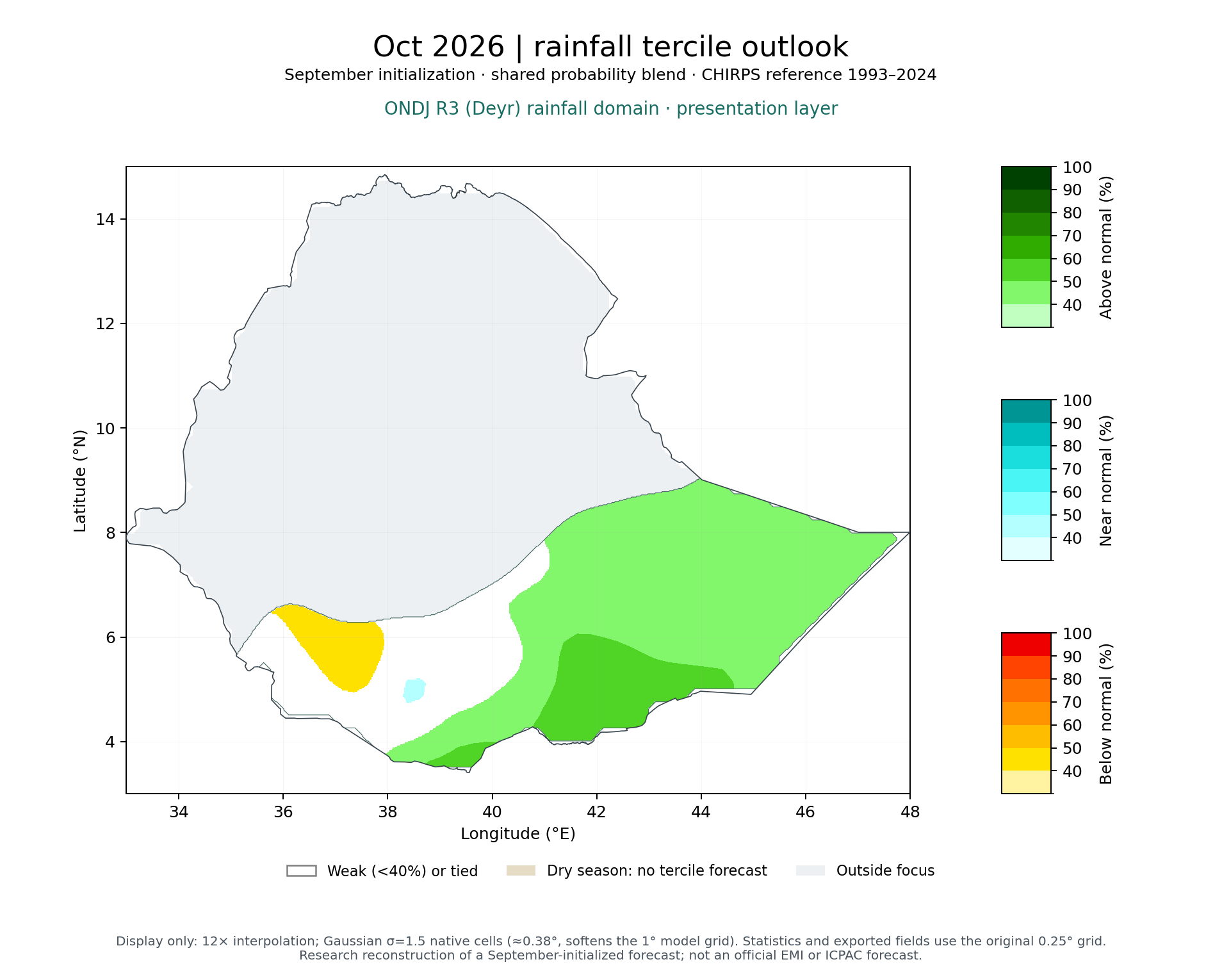 Oct 2026
B 26% · N 31% · A 42%
Target period ongoing (ends 31 Oct 2026)
-
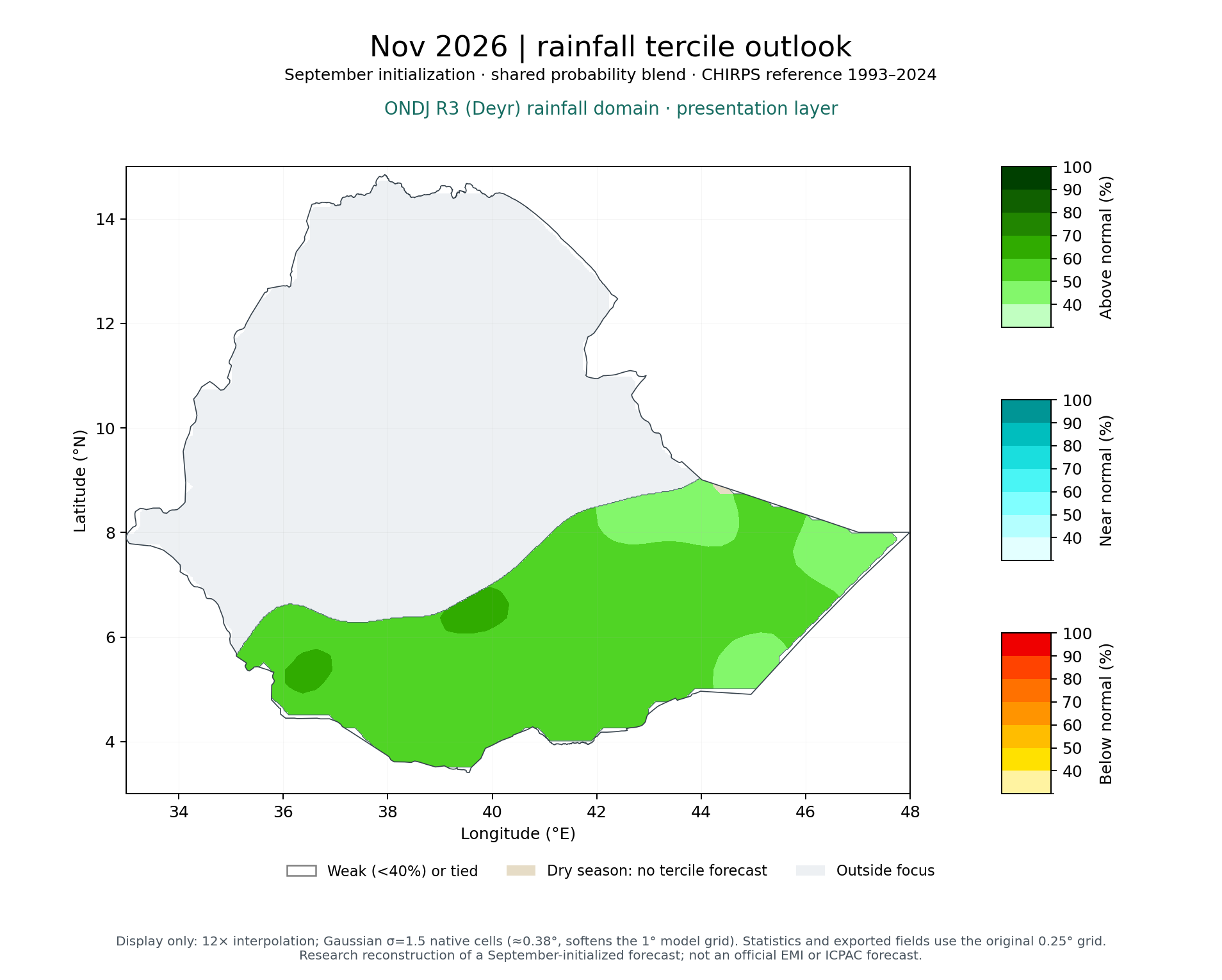 Nov 2026
B 20% · N 25% · A 54%
Target period starts 1 Nov 2026
-
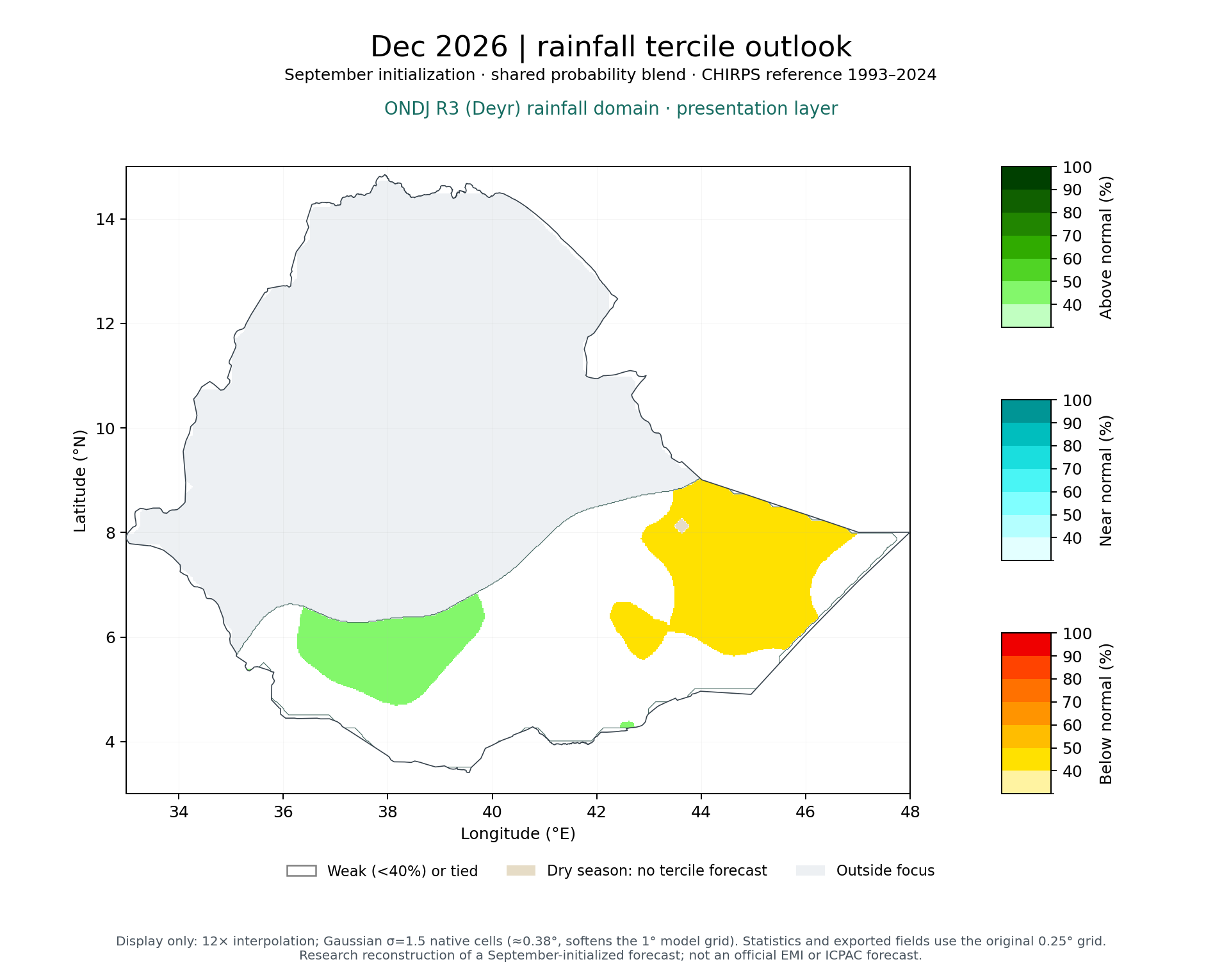 Dec 2026
B 36% · N 26% · A 38%
Target period starts 1 Dec 2026
-
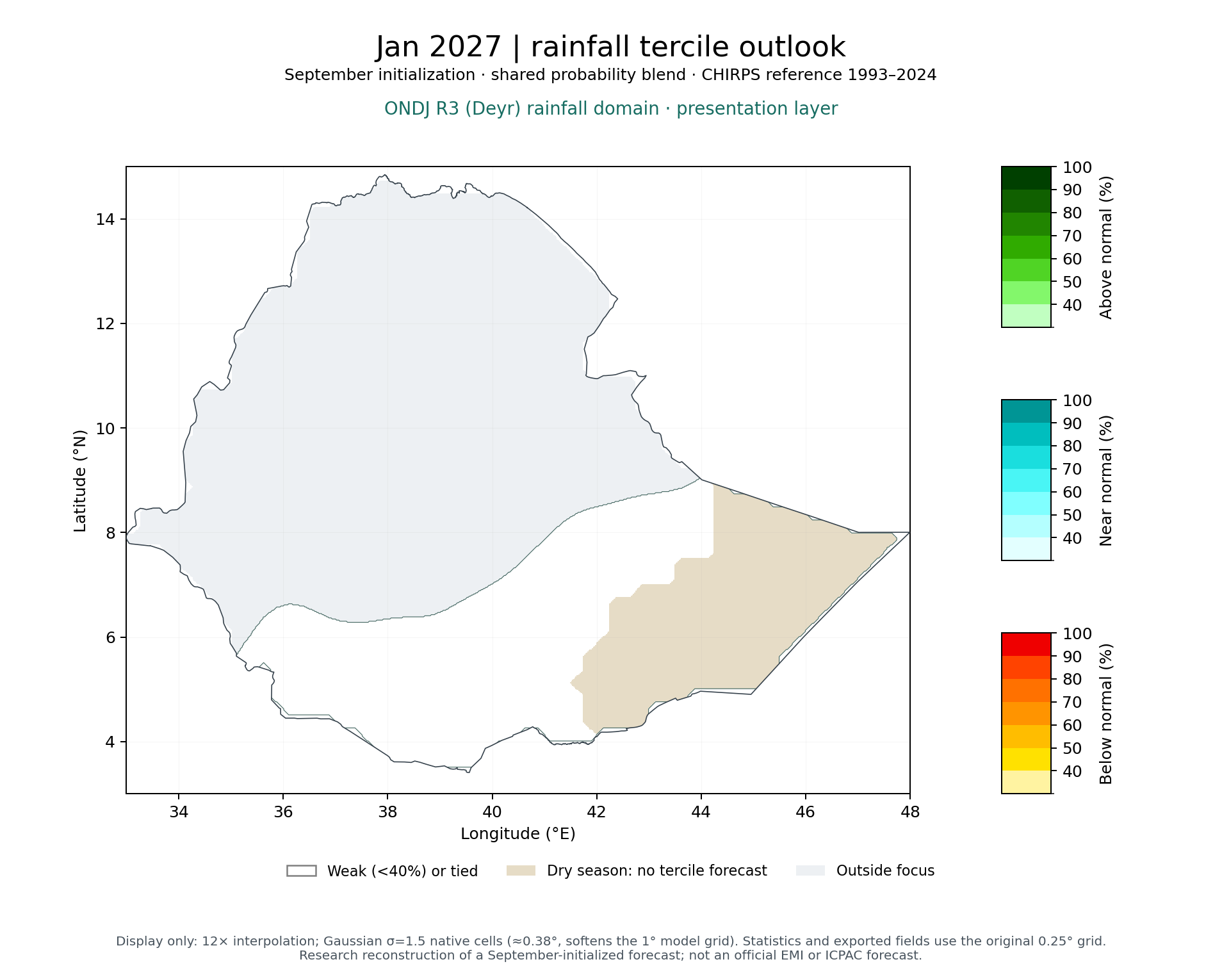 Jan 2027
B 32% · N 33% · A 36%
Target period starts 1 Jan 2027
What's new
- How statistical downscaling is implemented · release 2026-10-19.0, 2026-10-19
Display or explanatory-text change - Method selection with Benjamini-Hochberg · release 2026-10-17.3, 2026-10-17
Change to the scientific method - Real-time issue from 2027, statistical downscaling, more statistical power, dry-season maps · release 2026-10-17.2, 2026-10-17
Change to the scientific method · New evidence or diagnostics (method unchanged) · Display or explanatory-text change
Other forecast cycles
- JJAS 2026 — May initialization
5 of 5 targets verified · verification - FMAM 2026 — February initialization
5 of 5 targets verified · verification - FMAM 2026 — January initialization
5 of 5 targets verified · verification
Research behind the method
- Bias correction
13 rainfall-amount corrections against the operational MVS; suggestions, shadow forecasts and validation. - Probability calibration
Phases 1–3 against the published probabilities; the climatology blend stays. - Amount and range shadow
EMOS medians and 10–90% ranges next to the MVS ensemble, scored season by season. - Leung–Dirichlet calibration
Member-wise modified-Leung correction + identity-anchored Dirichlet, each stage tested against the published one.